
If you’re heading to Vietnam, you’re in for a serious treat. The place has it all: dramatic scenery, incredible history, people with a wonderfully playful spirit who love nothing more than having a laugh, and food that will genuinely ruin your local takeaway back home forever.
It’s also a remarkably easy country to travel around (for the most part). The cross-country transport is dead handy, the stays are great quality, and most locals speak a bit of English.
That said, nothing breaks the ice faster than throwing out a few local words. You don’t need to be fluent - nobody expects you to give a political speech in Vietnamese. But showing up, having a crack at the language, and shouting a local toast over a bowl of street noodles goes a long way.
Here is what you actually need to know about the language, minus the confusing textbook jargon, plus the essential phrases that will make you an absolute legend at the dinner table.
First Off: Why Vietnamese Isn't as Scary as It Sounds
If you’ve ever looked at Thai or Khmer, you’ll know the scripts look like beautiful, complex art - their written language is so alien for a lot of us westerners. Vietnamese is totally different.
Back in the day, the country used a pictorial script similar to Chinese. But nowadays, everything is written in a Latin-based alphabet that was introduced by Portuguese missionaries apparently.
It uses 29 familiar letters (though they don’t use F, J, W, or Z). Because it’s written in Latin script, you can actually read the signs on the street which makes travel that bit easier!
The Tone Thing… (Don't Panic)
Vietnamese is a tonal language. The same basic word can mean six totally different things depending on how you pitch your voice.
Take the word Pho or Phở, to be exact:
In a low, dropping tone (phò): You’re no longer asking for noodle soup - you’ve just accidentally asked the waiter for a lady of the night, so be careful haha!!
Pitch it sharp and rising (phố): Now you’re saying “street” or “city”.
Say it with that classic rising, questioning curl at the end (phở): Congratulations, you’ve hit the jackpot - you’re getting a piping hot bowl of delicious beef noodle soup.
So if you pitch it wrong at lunch, you might end up ordering a street, a local worker, or a bowl of noodles. But don’t stress - the locals are dead used to tourists butchering it and will know what you’re after and appreciate your effort either way.
Sounds a bit mental, right? The good news is that the written accents on the letters actually tell you which tone to use.
No symbol (ma): Flat and level, means ghost.
Deep accent (mà): Low tone, means which/but.
Sharp accent (má): Rising tone, means mother - just like us Dubliners say it!
Heavy dot underneath (mạ): Low and clipped, means rice seed.
To be completely honest with you, as a foreigner in your 30s or 40s, you’re going to mess the tones up at first. Everyone does. But the locals have great patience, and in the context of ordering a cold beer or a bowl of Pho, they’ll know exactly what you’re looking for.
The Essential Cheat Sheet
Here are the practical, everyday phrases you’ll actually use on the road with us.
1. The Everyday Basics (Politeness Goes a Long Way in Vietnam)
Hello / Hi: Xin chào (Pronounced: Sin chow)
Thank you: Cảm ơn (Pronounced: Kahm uhn)
Please: Làm ơn (Pronounced: Lahm uhn)
Sorry / Excuse me: Xin lỗi (Pronounced: Sin loy)
No problem: Không có gì or more casually Không sao (Pronounced: Khom koh zee or Khom sao)
Do you speak English?: Bạn có nói tiếng anh không? (Pronounced: Bahn koh noy tyeng ahng khong?)
I don’t understand: Tôi không hiểu (Pronounced: Toy khong hyew)
2. Market Tactics & Getting Around
How much? Bao nhiêu? (Pronounced: Bow nyew?)
Where is...? Ở đâu? (Pronounced: Uh dow?)
The bill, please: Tính tiền (Pronounced: Tin tyen)
3. How to Get Served Like a Pro (Em ơi, Chị ơi, Anh ơi)
If you sit silently waiting for a waiter to pop over with a leather-bound menu in Vietnam, you’ll be sitting there until next Tuesday. Calling someone over is completely expected - you just need to pick the right title based on who you’re talking to. It might seem rude to shout out but it is perfectly normal in Vietnam.
Calling a younger server (male or female): “Em ơi!” (Pronounced: Ehm oy!). Literally translates to “Hey, younger sibling!” This is your go-to in 90% of cafes, bars, and street food joints.
Calling an older female server: “Chị ơi!” (Pronounced: Chee oy!). “Hey, older sister!” Perfect for the lovely lady running the roadside Bahn Mi cart.
Calling an older male server: “Anh ơi!” (Pronounced: Ahng oy!). “Hey, older brother!”
Shout a friendly “Em ơi, tính tiền!” (Hey, bill please!) across a packed street food stall, and the locals will look at you like you’ve been living in Hanoi for ten years.
Social Situations & Drinking Customs (The Important Stuff)
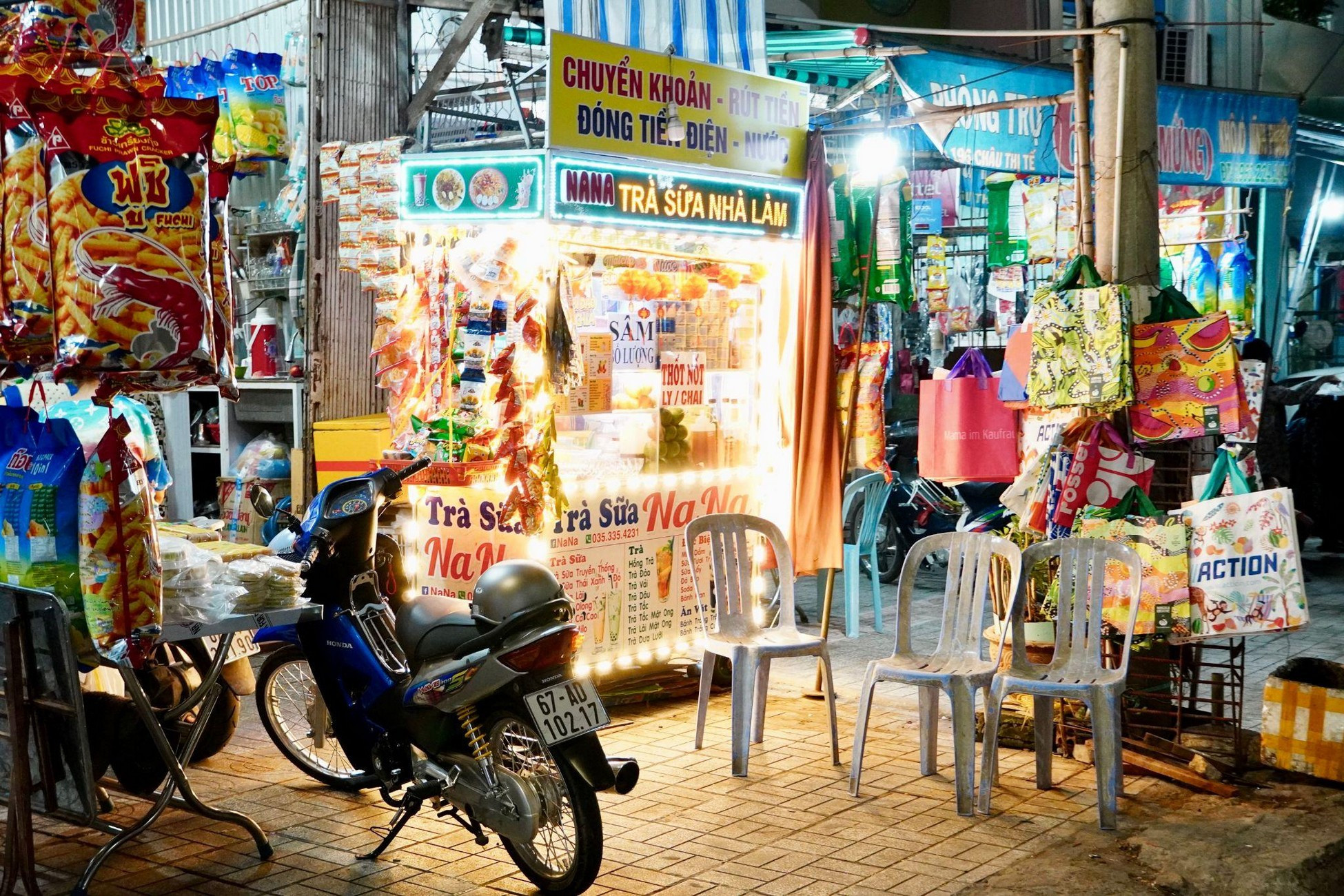
Eating and drinking in Vietnam is a massive collective sport. You don’t just sit in a corner quietly picking at your plate; you share dishes, sit on tiny plastic stools on the pavement, and clink glasses with everyone at the table.
If you want to blend right in with the locals during night market runs, keep these in your back pocket:
One, two, three, cheers! Một, hai, ba, dô! (Pronounced: Mote, hye, bah, ZOH!). This is the big one. You’ll hear this roared across street food joints every five minutes - they love it!!
Bottoms up / 100%: Trăm phần trăm (Pronounced: Trahn fuhn trahn). Use this when someone wants you to drain the glass.
Delicious! Ngon lắm! (Pronounced: Ngon lahm!). Say this to the person who cooked your food and you’ll get a smile from ear to ear.
I’m tipsy: Tôi đang say (Pronounced: Toy dang sigh). Handy for when the local rice wine starts doing the talking and you need a break from locals filling you up with it.
No 16-Bed Dorms, No Party Buses
Look, Vietnam is legendary, but how you do it matters. In your 20s, you might have been happy staying in a 16-bed hostel dorm full of 18-year-olds playing drinking games.
In your 30s and 40s? Absolutely not. You want proper sleep, a great shower, good transport, and boutique stays without losing an ounce of the local atmosphere.
That’s exactly why we built our Adventure After 30 Vietnam Expedition. We swap the chaos for curated street food tours, private boats through Ha Long Bay, and character-rich stays - all alongside a small group of people who are at the exact same stage of life as you.
Our Vietnam Small Group Expedition drops as part of our Southeast Asia Launch. We’re keeping groups small, comfortable, and packed with proper local experiences.
Hopefully see you there!
Talk soon guys,
Joe